
Climate & Weather in Texas
Texas spans multiple climate zones (IECC 2-4) from humid subtropical Gulf Coast to semi-arid West Texas and hot-dry desert in the far west. Defining conditions for roofing: extreme summer heat and intense UV exposure statewide, high humidity and salt air along the Gulf Coast (Houston, Corpus Christi, Galveston), frequent severe convective storms producing large hail across the 'Hail Alley' corridor from North/Central Texas (Dallas-Fort Worth, San Antonio) through the Panhandle, hurricane and tropical storm landfall risk along the entire coast (Houston/Galveston to Corpus Christi to Rio Grande Valley), high tornado frequency in North Texas and the Panhandle, and growing wildfire/WUI exposure in the Hill Country and West Texas grass/brushlands. Winter ice storms occasionally affect North Texas; heavy snow load is not a significant design driver except in isolated Panhandle events.
Weather Perils to Plan For
Hail
DFW, San Antonio, and North/Central Texas sit within one of the most hail-prone corridors in the US; frequent 1-2+ inch hail events drive asphalt shingle replacement cycles and are the single biggest driver of metal roof interest statewide.
Hurricane / tropical storm wind
Entire Gulf Coast (Houston, Galveston, Corpus Christi, Beaumont, Rio Grande Valley) is exposed to landfalling hurricanes and tropical storms; wind-borne debris and uplift are primary design concerns, governed by IRC/IBC wind provisions and Texas Department of Insurance windstorm rules in designated catastrophe areas.
Tornado
North Texas and the Panhandle see some of the highest tornado frequencies in the country; metal's fastening and uplift resistance perform better than shingles in straight-line and lower-EF wind events, though no roofing product is tornado-proof.
High UV / extreme heat
Long, intense summers statewide accelerate asphalt shingle degradation and drive attic/energy-cost concerns; cool-roof reflective metal coatings reduce cooling loads.
Coastal salt air / corrosion
Gulf Coast metros require marine-grade coatings and corrosion-resistant substrates (e.g., Galvalume with premium PVDF/Kynar finishes, or aluminum) within roughly 1-3 miles of the coast.
Wildfire / WUI
Hill Country (Austin/San Antonio periphery, Bastrop area) and West Texas grasslands have documented wildfire exposure; Class A fire-rated metal roofing is relevant in these WUI zones, less so statewide.
Heavy snow load
Not a meaningful statewide design driver; occasional ice/snow events in North Texas and the Panhandle but nothing comparable to northern-tier states.
Recommended Metal Roof Types
Standing seam steel (concealed fastener, 24-26 gauge, PVDF/Kynar 500 finish)
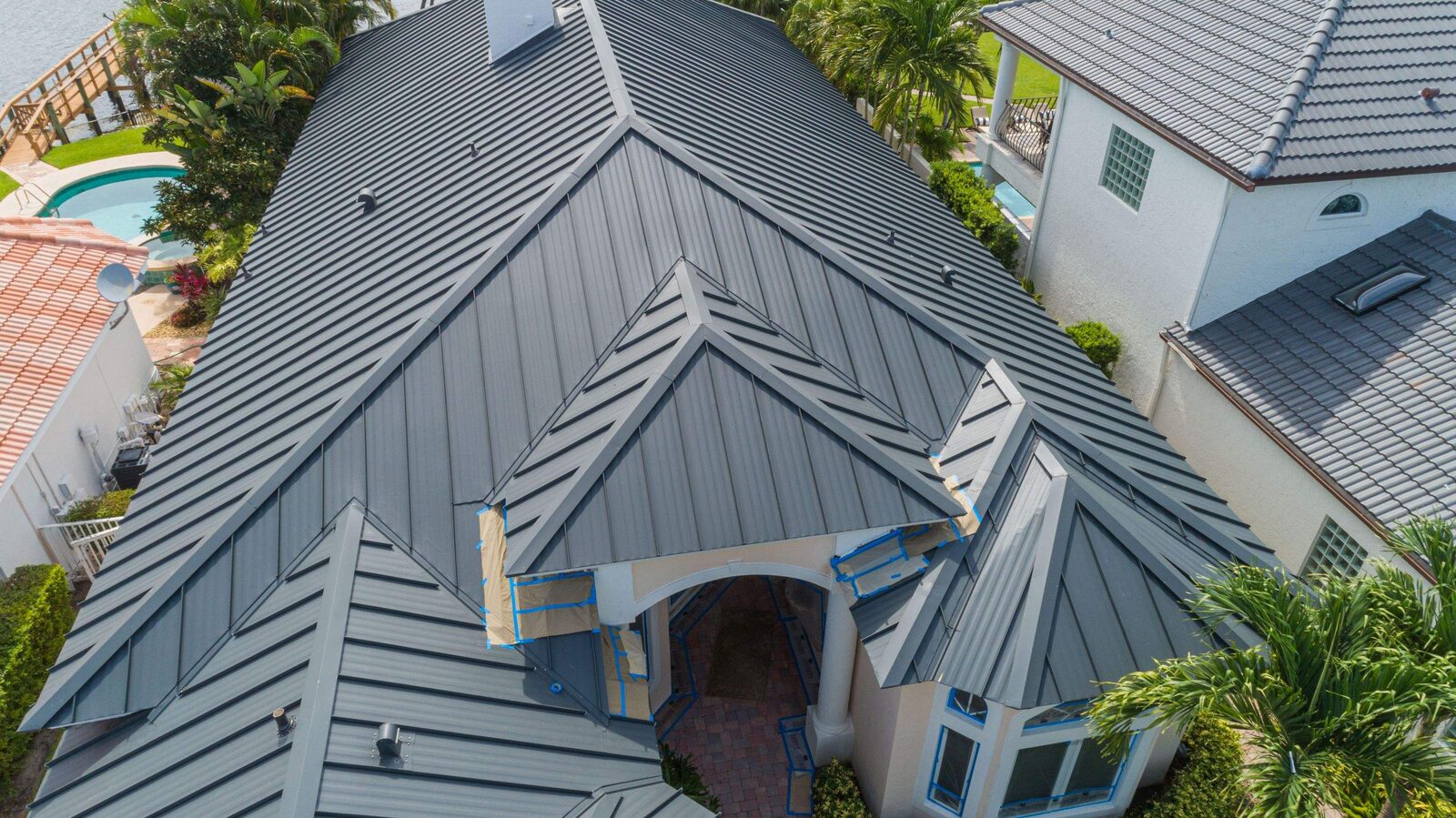
Best overall performer for hurricane wind-uplift resistance (rated systems tested to 120-150+ mph), thermal movement tolerance in extreme heat swings, and premium curb appeal for Hill Country and coastal custom homes; concealed fasteners eliminate the leak points that fail first in wind events.
Stone-coated steel shingle/tile profile
Popular where HOAs or historic character require a traditional shingle or tile look (San Antonio, Central Texas Spanish-style neighborhoods) while gaining Class 4 impact rating for hail and better wind performance than composition shingle.
Aluminum standing seam
Preferred within a few miles of the Gulf Coast (Galveston, Corpus Christi, Port Aransas) because it will not rust from salt-air corrosion the way coated steel eventually can.
Exposed-fastener steel (26-29 gauge ag panel)
Cost-effective, widely used on rural ranch homes, barns, and outbuildings across West and Central Texas; lower upfront cost but requires more maintenance of fastener seals in high-UV/thermal-cycling climate.
Class 4 impact-rated metal panels (any profile)
Specifically marketed and installed to qualify for Texas insurer hail-discount programs given the DFW/Central Texas hail corridor is the top loss driver in the state.
Building Code, Wind & Fire
| Building Code Notes | Texas has no single statewide residential building code; adoption is at the local/county level, with most major metros (Houston, Dallas, Austin, San Antonio, Fort Worth) adopting versions of the International Residential Code (IRC) with local amendments. Coastal counties within the Texas Department of Insurance (TDI) designated Catastrophe/Seacoast area require roofing products to carry TDI product evaluation/approval and meet windstorm building code requirements administered through the Texas Windstorm Insurance Association (TWIA) program; metal roofing systems typically need a current TDI WPI-8 (Windstorm Inspection) approval and installation per manufacturer wind-rated specs to qualify. Design wind speed maps follow ASCE 7 as referenced by IRC, with coastal counties designed to roughly 130-150+ mph ultimate wind speeds versus roughly 105-115 mph in interior North/Central Texas. |
|---|---|
| Wind Requirements | Interior Texas (DFW, Austin, San Antonio): IRC/ASCE 7 basic wind speeds generally 105-115 mph (ultimate design wind speed), requiring metal panel systems tested/rated (e.g., UL 580/1897, ASTM E1592) for corresponding uplift pressures. Gulf Coast counties within the TDI seacoast/catastrophe area: design wind speeds up to 130-150 mph depending on exact location, requiring WPI-8 windstorm-approved roofing assemblies, enhanced fastening schedules, and often engineered standing seam clip systems rather than exposed-fastener panels. |
| Fire Requirements | Most Texas jurisdictions do not mandate Class A roofing statewide, but Wildland-Urban Interface (WUI) overlay zones in Hill Country communities (parts of Travis, Hays, Bastrop, Comal counties) and some municipal codes near WUI areas increasingly require or incentivize Class A fire-rated assemblies; metal roofing is inherently noncombustible and typically achieves Class A ratings as part of a listed assembly, a straightforward advantage over wood shake in these zones. |
Insurance & Adoption
Typical Installed Cost
Installed residential metal roofing in Texas typically runs about $9-$16 per sq ft for standing seam steel (roughly $850-$1,600 per square/100 sq ft), $6-$10 per sq ft for exposed-fastener steel panels, and $10-$18+ per sq ft for aluminum standing seam or premium stone-coated steel systems, before insurance offsets; complex Hill Country rooflines, steep pitches, and coastal wind-rated assemblies push toward the higher end.
Popular Metal Roof Colors in Texas
- Galvalume/silver-gray (classic, especially ranch and ag-style homes)
- Charcoal / matte black (modern farmhouse and Hill Country custom homes)
- Bone white / off-white (reflective, popular for cooling-cost-conscious buyers)
- Dark bronze / brown (blends with Hill Country stone and earth tones)
- Colonial red / barn red (traditional rural and ranch aesthetic)
- Slate blue-gray (coastal homes, Galveston/Corpus Christi area)
- Forest/hunter green (rural and wooded Piney Woods East Texas properties)
Common Home Styles
- Texas Hill Country / ranch style (low-slope, wide eaves, native stone)
- Traditional single-story ranch (especially DFW, San Antonio, Panhandle)
- Spanish Colonial / Mission Revival (Central and South Texas, historically tile-roofed)
- Farmhouse / modern farmhouse (statewide, especially exurban and rural)
- Craftsman and transitional suburban tract homes (fast-growing suburbs: Frisco, McKinney, New Braunfels, Katy)
- Custom/luxury estate homes with standing seam accent roofs (Austin Hill Country, Highland Park)
- Coastal/raised pier homes on the Gulf Coast (Galveston, Corpus Christi, Rockport)
Metro Areas We Serve in Texas
Amarillo
Potter County, Randall County, Armstrong County
Austin-Round Rock-San Marcos
Travis, Williamson, Hays
Beaumont-Port Arthur, TX Metropolitan Statistical Area
Jefferson County, Orange County, Hardin County
Corpus Christi
Nueces County, San Patricio County
Dallas
Dallas County, Collin County, Denton County
El Paso
El Paso County, Hudspeth County
Fort Worth
Tarrant, Parker, Johnson
Galveston (Galveston County, part of the Houston–The Woodlands–Sugar Land MSA)
Galveston County
Houston
Harris County, Fort Bend County, Montgomery County
Killeen-Temple
Bell County, Coryell County, Lampasas County
Lubbock
Lubbock County, Crosby County, Lynn County
McAllen-Edinburg-Mission
Serving McAllen-Edinburg-Mission and surrounding communities.
San Antonio-New Braunfels, TX Metropolitan Statistical Area
Bexar County, Comal County, Guadalupe County
Waco
McLennan County, Falls County, Bosque County
Top Cities in Texas
Get a Free Metal Roofing Estimate in Texas
Tell us about your project and a certified Sherwin MetalVue professional in your area will follow up with a free, no-obligation estimate.
Sherwin-Williams is not liable for the conduct, performance, or workmanship of any contractor.