
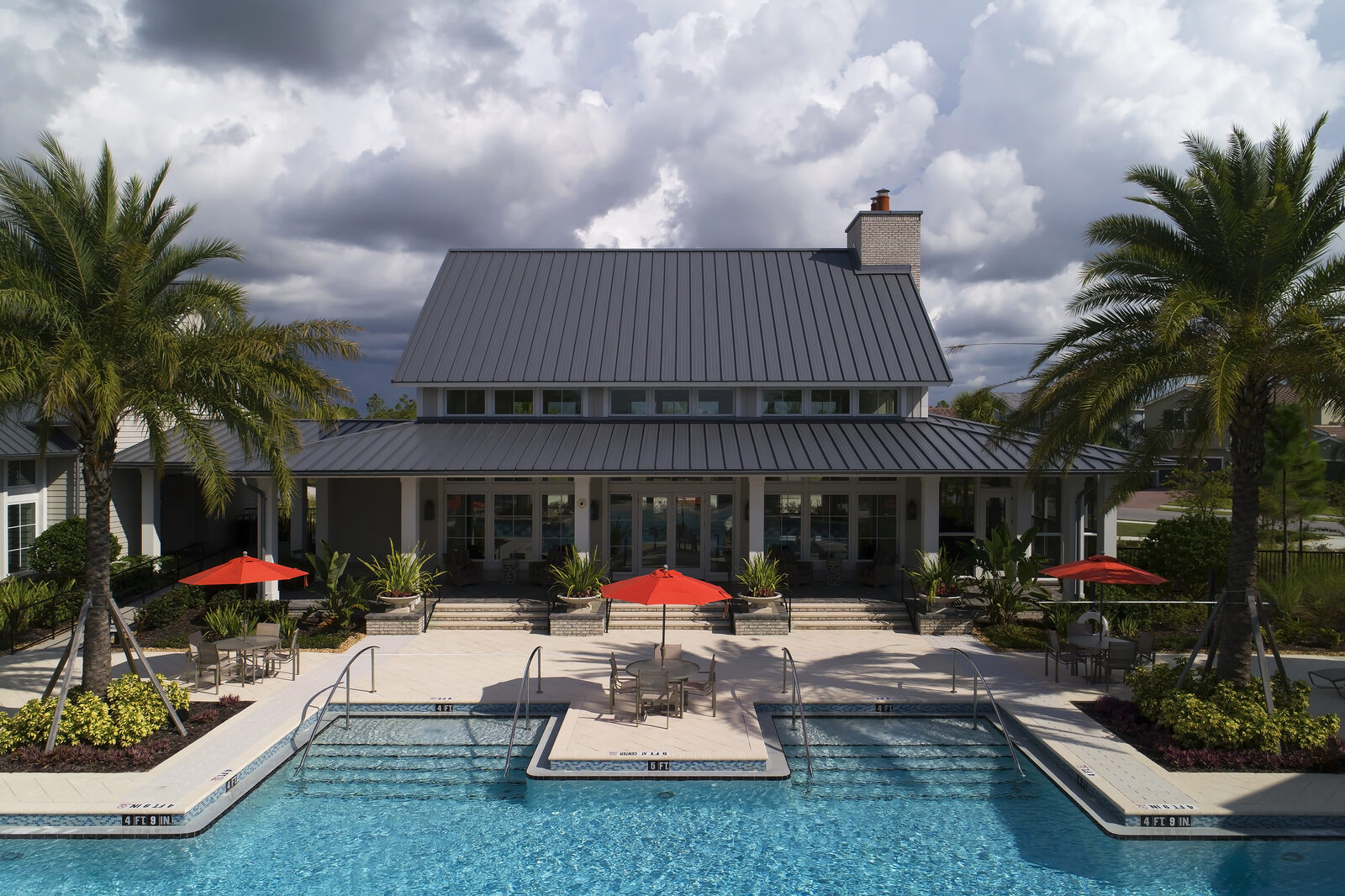
Overview
Premium concealed-fastener metal roofing system built from vertical interlocking panels with raised seams (ribs) running from ridge to eave; panels are joined either by snapping together (snap-lock), by hand/machine-crimping (mechanical/mechanically-seamed lock), or by an exposed-slot fastener flange hidden under the adjoining panel's leg (nail-strip/fastener-flange). It is the highest-performing, longest-lasting, and most expensive mainstream residential roofing category in the US, typically installed over steel (Galvalume/G-90 or aluminized), aluminum, zinc, or copper substrates finished with PVDF (Kynar 500/Hylar 5000) or SMP coil coatings.
Specifications
| Materials | Galvanized steel (G-90 zinc coating), Galvalume steel (zinc-aluminum alloy coated steel, most common substrate), Aluminum (preferred for coastal/salt-air environments), Zinc (premium, patina-forming), Copper (premium, patina-forming, highest cost), Aluminized steel |
|---|---|
| Profiles | Snap-lock (clip-fastened, panel legs snap together, no seaming tool required), Mechanical single-lock (panel legs folded once with a mechanical seamer), Mechanical double-lock (panel legs folded twice, highest weathertightness, used on low-slope 2:12+ applications), Nail-strip / fastener-flange (screwed directly through a flange, adjoining panel snaps over to conceal fasteners) |
| Gauge / thickness | Steel: 22-gauge (heaviest, commercial-grade), 24-gauge (standard/recommended for true engineered standing seam and best UL 2218 Class 4 hail performance), 26-gauge (economical residential option, often less rigorously tested/engineered), 29-gauge (thinnest, generally not recommended for true standing seam, more common on utility/agricultural panels). Aluminum panels commonly run.032 in. to.040 in. thick equivalent. |
| Panel widths | Most common residential panel width is 16 in.; other common widths include 12 in. and up to 19.5 in., with custom widths available from many manufacturers; seam/rib height typically 1 in. to 2 in. |
| Material cost | $10–$35/sq ft |
| Lifespan | 40–70 yr |
| Wind rating | Concealed-clip standing seam systems routinely achieve UL 580 Class 90 uplift ratings and independent ASTM E1592 structural testing showing sustained wind resistance of 140+ mph, with some engineered systems tested to 160–200 mph; performance depends heavily on clip spacing, panel profile, and deck attachment per manufacturer engineering, not material alone. |
| Fire rating | Class A fire rating (highest, per UL 790) is standard for standing seam metal roof assemblies, making it a preferred choice in wildfire-prone regions such as California and other Western Wildland-Urban Interface zones. |
| Hail performance | 24-gauge steel standing seam systems commonly achieve UL 2218 Class 4 impact resistance (the highest rating), which can qualify homeowners for insurance premium discounts in many states; thinner-gauge (26/29) and snap-lock-only systems may not carry the same Class 4 certification, so buyers should confirm UL 2218 rating at the specific gauge/profile level, not just "standing seam" generically. |
| Weight | Lightweight relative to tile/slate: roughly 50–150 lb per square (100 sq ft) depending on material and gauge, versus ~250–450 lb/square for asphalt shingles and 600–1,500+ lb/square for concrete/clay tile. |
| Fastener type | Concealed: snap-lock systems use concealed clips screw-fastened to the deck, with panel legs snapping over the clip; mechanical-lock systems use concealed clips plus panels crimped together with a mechanical seamer (single- or double-lock); nail-strip/fastener-flange systems use exposed screws driven through a slotted flange that is then hidden under the next panel's overlapping leg — no fastener heads are visible on the finished roof face in any sub-type. |
Pros
- Exceptional lifespan (40-70 years, often outlasting two or more asphalt shingle roof cycles)
- Class A fire rating (UL 790) - strong choice for wildfire-prone regions
- High wind uplift resistance (UL 580 Class 90; many systems 140-200 mph rated)
- Concealed fasteners eliminate the #1 leak point of exposed-fastener metal panels and improve weathertightness over the roof's life
- Excellent snow-shedding performance, reduces ice-dam and snow-load risk in cold climates
- 24-gauge systems can achieve UL 2218 Class 4 (highest) hail impact rating, potentially lowering homeowners insurance premiums
- PVDF (Kynar 500/Fluropon) coatings hold color and gloss for decades with minimal chalking/fading
- Lightweight compared to tile or slate, reducing structural loading concerns on some homes
- Energy efficient - reflective coatings and optional cool-roof pigments can reduce attic heat gain and cooling costs; many colors qualify for ENERGY STAR/cool-roof ratings
- Low maintenance - no algae/moss susceptibility like shingles, no periodic recoating needed
- Recyclable material and often contains recycled content, appealing to sustainability-minded buyers
- Excellent substrate for solar panel mounting (many systems allow clamp-on, non-penetrating solar racking)
- Strong resale value / curb-appeal premium versus asphalt shingles
Considerations
- Highest upfront cost among common residential roofing materials (roughly 2-3x asphalt shingles per square foot)
- Requires specialized, manufacturer-certified installers for proper performance and to preserve weathertightness warranties - fewer qualified installers than for shingles
- Mechanical (double-lock) systems require expensive portable seaming equipment and more labor time, raising installed cost
- Snap-lock systems are less weathertight than mechanical-seam and not recommended below roughly 3:12 pitch; can loosen over time from repeated thermal expansion/contraction cycles in extreme temperature-swing climates
- Nail-strip/fastener-flange is the lowest-performing of the three sub-types, most sensitive to installation precision (first panel alignment errors propagate across the roof), and least tolerant of thermal movement if screws are over-torqued
- Noise perception during heavy rain/hail can be higher than shingles without proper solid decking/underlayment/insulation (largely mitigated with standard solid-substrate installation)
- Oil-canning (visible waviness in flat pan areas) is a cosmetic issue that can occur, especially on wider panels or lower gauges, though largely a perception/aesthetic issue not a performance defect
- Galvalume steel is vulnerable to accelerated corrosion in close coastal salt-air exposure (roughly within 1,000-1,500 ft of breaking surf) unless upgraded to aluminum or a marine-grade coating
- Repairs/replacement of an individual damaged panel can be more complex and costly than replacing a few shingles, sometimes requiring partial re-fabrication or removal of adjacent panels
- Dissimilar-metal (galvanic) corrosion risk if incompatible flashing, fasteners, or accessories are used
Where Standing Seam Metal Roof performs best
Climates
- Heavy snow / freeze-thaw regions (smooth panel surface sheds snow, reduces ice dams)
- Hurricane-prone / high-wind coastal regions (high UL 580 wind uplift ratings)
- Wildfire-prone / Wildland-Urban Interface regions (Class A fire rating)
- Hail-prone regions (with 24-gauge, UL 2218 Class 4-rated systems)
- Hot, high-UV climates (reflective/cool-roof PVDF coatings reduce heat gain)
- Humid, salt-air coastal environments (with aluminum or PVDF-coated substrates, avoiding bare Galvalume near breaking surf)
Sherwin-Williams Finish
Sherwin-Williams Fluropon 70% PVDF (Kynar 500/Hylar 5000 resin) coil coatings are an industry-standard, "gold standard" finish widely specified for standing seam standing-seam panels; Fluropon offers superior UV, color, gloss, chalk, and fade resistance versus SMP (silicone-modified polyester) alternatives, is available in a wide range of standard and custom colors/metallics, and is backed by extensive multi-decade field and accelerated-weathering testing meeting AAMA 2605 and ASTM performance criteria - a strong technical and marketing fit for a Sherwin-Williams-branded MetalVue residential standing seam product line, since it lets MetalVue claim the same PVDF resin chemistry used across the premium end of the architectural metal roofing/wall panel industry.
Look & Aesthetics
Clean, linear, modern-to-traditional silhouette formed by tall vertical ribs (typically 1-2 in. seam height) spaced evenly across each panel; the concealed-fastener face reads as flat, unbroken metal with no visible screw heads, giving a sleek, architectural look that suits modern farmhouse, contemporary, craftsman, mountain/cabin, and coastal builds. Available in dozens of PVDF/Kynar 500 painted colors plus metallic and matte finishes; the ribbed vertical pattern strongly differentiates it visually from shingles, tile, or corrugated exposed-fastener panels and is broadly regarded as a premium, curb-appeal-boosting roof aesthetic that can support resale value.
What Drives Installed Cost
Fully installed pricing for steel or aluminum standing seam typically runs $10–$16/sq ft on the low end up to $17–$24/sq ft for mid-range branded systems, with high-end/complex jobs reaching $30–$39/sq ft; copper or zinc standing seam runs $20–$40+/sq ft. Total project cost for a typical 2,000 sq ft residential roof averages roughly $19,000, with most jobs falling between $20,000–$34,000 (materials + labor); labor alone is typically $6–$14/sq ft or $150–$300 per roofing square. Snap-lock is the least expensive sub-type to install (no seaming equipment needed); mechanical (single/double)-lock costs more due to seamer rental/labor time; nail-strip is generally the cheapest and simplest of all three, often suitable for DIY on simple roof geometries.
Warranty
Most major manufacturers offer 30–50 year finish/paint warranties (PVDF/Kynar 500 finishes typically carry the longest color/chalk/fade warranties), plus separate substrate (perforation) warranties often 25–50 years, and weathertightness warranties (typically 20–30 years) that usually require installation by a manufacturer-certified applicator. Some premium systems are marketed with "lifetime limited" warranties on the substrate. Warranty terms vary significantly by coating (PVDF vs. SMP), coastal proximity exclusions/limitations (Galvalume often has reduced or void warranty within roughly 1,000–1,500 ft of saltwater, aluminum or PVDF recommended instead), and whether installation used a certified installer.
Get matched with a certified MetalVue installer
Compare Standing Seam Metal Roof pricing and options with a free, no-obligation estimate.