
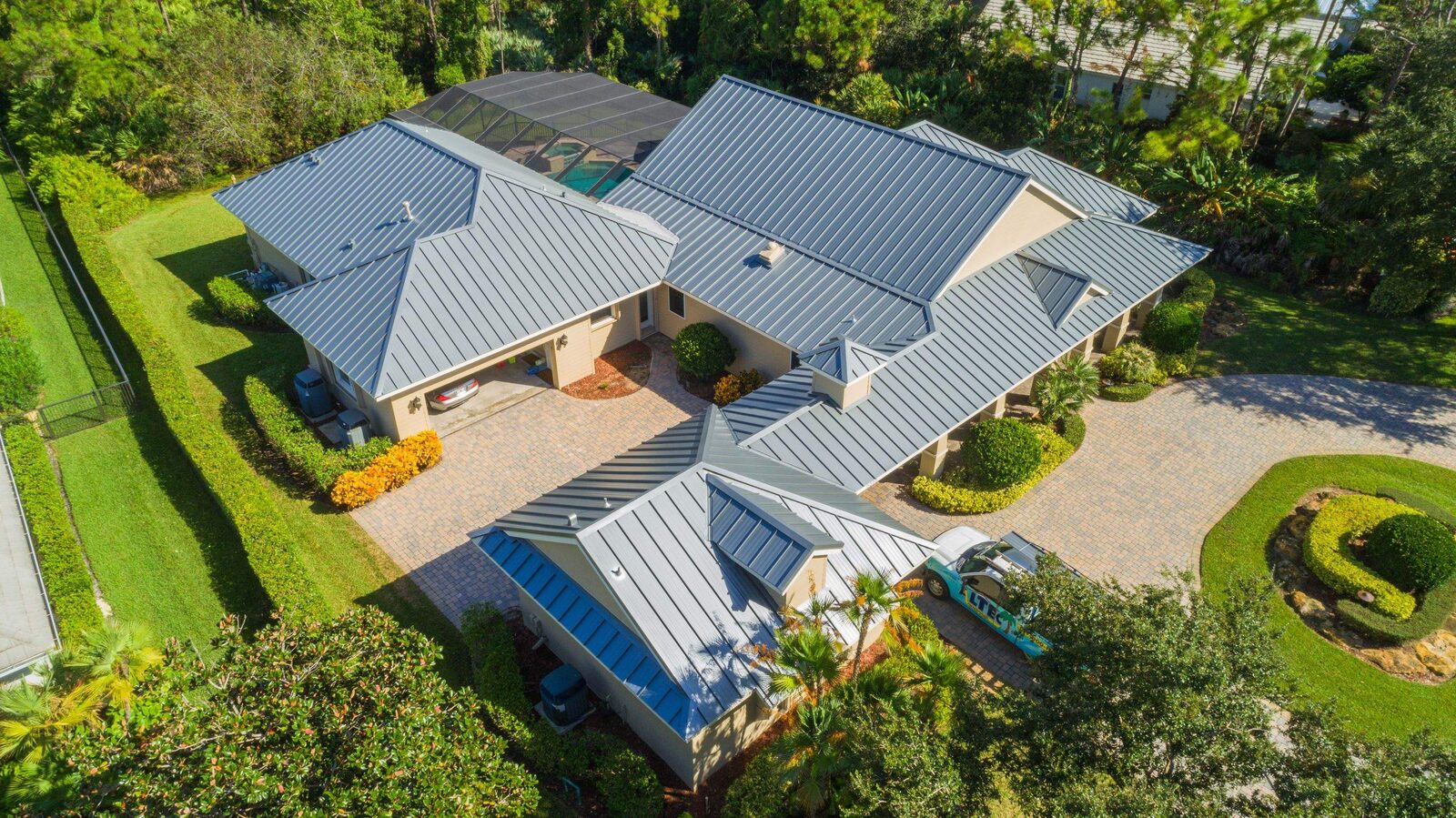
Overview
A technical knowledge-base entry compiling 2025-2026 residential metal roofing specifications: sheet-metal gauge/thickness options, standing-seam and exposed-fastener panel widths/profiles, clip systems (fixed vs. floating) and fastener types, underlayment requirements (synthetic vs. self-adhered ice-and-water shield vs. high-temp), attic ventilation ratios and ridge/soffit venting for metal roofs, and flashing/accessory systems (ridge cap, valley, Z-closure, pipe boot). Includes cost ranges, performance ratings (UL 2218 hail, wind uplift), and Sherwin-Williams MetalVue/Fluropon coating context.
Specifications
| Materials | Galvanized steel (G-90 zinc coating), Galvalume steel (55% aluminum-zinc alloy coating, AZ-50/AZ-55), Aluminum, Copper, Zinc, Stone-coated steel |
|---|---|
| Gauge / thickness | Common residential steel gauges run from 29 (lightest, ~0.014-0.015 in.) to 22 (heaviest, ~0.030 in.), with 24-gauge (~0.024-0.025 in.) and 26-gauge (~0.018-0.019 in.) as the two dominant residential specs. 29-gauge is the thinnest/most economical, typically limited to low-cost exposed-fastener panels on sheds, agricultural buildings, or budget re-roofs — it dents more easily and is not recommended in hail-prone or heavy-snow regions. 26-gauge is the standard "mid-tier" choice for standard residential standing-seam and exposed-fastener roofs in moderate climates. 24-gauge is the most common gauge specified for residential standing-seam projects where durability, oil-canning resistance, and hail/impact performance matter; it is frequently required by manufacturers for longer/wider panel runs and steeper-pitch aesthetic panels. 22-gauge (and heavier) is a premium option for maximum impact and wind resistance, typically in high-hail or coastal high-wind markets. Aluminum and copper panels use different, non-directly-comparable gauge/thickness conventions (e.g., aluminum commonly 0.032-0.040 in.).</gauge_or_thickness> <parameter name="weight_class">Approximate installed weights: 29-gauge steel panels ~0.6-0.8 lb/sq ft; 26-gauge ~0.8-1.0 lb/sq ft; 24-gauge ~1.0-1.2 lb/sq ft; 22-gauge ~1.4-1.6 lb/sq ft. All steel panel systems are substantially lighter than asphalt shingles (~2-4 lb/sq ft for architectural shingles) or tile (~6-12+ lb/sq ft), a factor relevant to structural load and re-roofing over existing shingles where code allows.</weight_class> <parameter name="panel_widths">Standing seam (concealed-fastener) panels: net coverage widths commonly 12", 14", 16", 18", and 24", with 16" and 18" being the most common on residential projects; panel coverage up to 24" is available from some manufacturers for lower-slope or budget applications. Exposed-fastener panels (5V-crimp, corrugated, R-panel/ribbed) typically cover 36" net width per sheet with rib spacing of 9" or 12" o.c. Panel lengths are typically custom roll-formed to the roof run (up to 40-50+ ft in some systems) to minimize horizontal seams/laps.</panel_widths> <parameter name="profiles">["Standing seam (snap-lock, concealed clip)", "Standing seam (mechanically field-seamed, single or double lock)", "Nail-strip / snap-together standing seam", "5V-crimp", "Corrugated (7/8\" or 1.25\" wave)", "R-panel / ribbed exposed-fastener panel", "Stone-coated steel shake/shingle/tile profile"] |
| Material cost | $10–$18/sq ft |
| Lifespan | Up to 70 yr |
| Hail performance | Metal roofing, especially stone-coated steel and heavier-gauge (24-gauge and thicker) standing seam, is commonly tested to and rated UL 2218 Class 4 — the highest impact-resistance classification, requiring the panel to withstand a 2-inch steel ball dropped from 20 feet, twice on the same spot on two test panels, with no cracking/splitting/rupture. Insurers in hail-prone states (e.g., Texas, Oklahoma, Colorado) increasingly offer premium discounts for Class 4-rated roofs. Thinner gauges (29-gauge) are more prone to cosmetic denting from hail even when they don't fail/leak, which can be a homeowner aesthetic concern separate from functional failure.</hail_performance> <parameter name="wind_rating">Metal roofing systems (particularly mechanically seamed standing seam) commonly carry wind-uplift ratings tested per UL 580/UL 1897 or ASTM E1592, with many systems rated for sustained winds well above 120-140 mph when properly installed with manufacturer-specified clip spacing and fastening patterns; this makes metal a preferred choice in coastal high-velocity hurricane zones (HVHZ), including Florida Building Code and Miami-Dade NOA-approved assemblies. |
| Fastener type | Two families: (1) Concealed-fastener systems (standing seam) use hidden clips screwed to the deck/substrate that engage the panel's vertical leg — clips are either FIXED (one-piece, screwed directly through to the deck, no panel movement allowed; used on shorter runs and at a roof's fixed point) or FLOATING/expansion clips (two-piece, seamed into the panel leg, allow the panel to move with thermal expansion/contraction; recommended for mechanically seamed panels and runs over ~30 ft). Clip/fastener spacing is typically 12"-24" o.c. along the panel length depending on wind load, panel width, and manufacturer spec. (2) Exposed-fastener systems use self-tapping or self-drilling hex-head screws driven directly through the panel face into purlins/decking, fitted with a bonded EPDM or neoprene sealing washer to seal the penetration; EPDM generally offers better long-term weather/UV resistance than neoprene, though neoprene is more chemical/oil resistant. Concealed clip-to-substrate fasteners are typically low-profile pancake-head screws hidden beneath the seam. Fastener material/coating should be matched to panel metal to avoid galvanic corrosion (e.g., stainless or coated fasteners with aluminum panels).</fastener_type> <parameter name="fire_rating">Metal roofing is inherently noncombustible; most metal panel roof assemblies (particularly over a compliant underlayment/deck assembly) achieve Class A fire rating (the highest UL 790 / ASTM E108 rating), a factor increasingly important in wildfire-urban-interface (WUI) zones such as California (Chapter 7A) and other high-fire-risk states. |
Pros
- Class A fire rating (noncombustible), valuable in WUI/wildfire zones
- UL 2218 Class 4 hail-impact rating achievable, especially 24-gauge+ and stone-coated products, often earning insurance premium discounts
- High wind-uplift ratings support use in hurricane/coastal high-wind code zones (HVHZ)
- Long service life (40-70 years) versus 15-30 years for asphalt shingles
- Lightweight relative to tile, often allows install over existing roofing where code permits
- PVDF (Fluropon/Kynar-type) coatings offer industry-leading, decades-long color and chalk/fade resistance
- Wide range of gauges and profiles allows cost/performance tuning by climate and budget
- Standing seam concealed-fastener systems minimize exposed penetrations, reducing long-term leak risk versus exposed-fastener screws
Considerations
- Higher upfront material and installed cost than asphalt shingles
- Exposed-fastener systems require periodic re-torquing/replacement of washered screws as EPDM/neoprene washers age (10-20 year washer life is a common failure point)
- Thinner gauges (29-ga) are prone to cosmetic denting from hail even without functional failure
- Oil-canning (visible waviness) is a cosmetic risk on wider panels/thinner gauges, especially on long uninterrupted runs
- Requires correct underlayment strategy (avoiding excess low-perm ice-and-water shield) to prevent trapped-moisture/condensation issues under the metal deck
- Ridge and soffit vent cutting/detailing at the ridge is more specialized than asphalt-shingle ridge vents, requiring metal-specific vented ridge caps
- Installation requires specialized roll-forming/seaming equipment and trained crews, limiting contractor availability in some markets
- Galvanic corrosion risk if fasteners/flashing metals are mismatched to the panel substrate
Where Residential Metal Roofing Systems: Gauges, Panel Widths, Clips/Fasteners, Underlayment, Ventilation & Flashing performs best
Climates
- Hail-prone regions (Texas, Oklahoma, Colorado, Great Plains hail alley)
- Hurricane/coastal high-wind zones (Florida, Gulf Coast, Atlantic coast HVHZ)
- Wildfire-urban-interface zones requiring Class A fire rating (California, Western states)
- Heavy snow-load regions (steep-slope standing seam sheds snow well)
- High-UV/sun-exposure regions where PVDF color retention matters
Home Styles
- Modern/contemporary residential
- Farmhouse and barndominium
- Mountain/lodge-style homes
- Coastal homes
- Ranch and craftsman homes seeking low-maintenance long-life roofing
Sherwin-Williams Finish
Sherwin-Williams' MetalVue program supplies coil coatings (applied to steel/aluminum coil before panel roll-forming) for both concealed- and exposed-fastener residential panel profiles across all common gauges (22-29 ga steel, standard aluminum thicknesses). Two primary resin platforms apply: Fluropon (70% PVDF/Kynar-type fluoropolymer, meeting/exceeding AAMA 2605 — the highest-performance coil-coating specification for color retention, chalk resistance, and weatherability) for premium/long-warranty residential standing seam, and WeatherXL (SMP, silicone-modified polyester) as a more economical option better suited to abrasion-prone or lower-budget exposed-fastener applications. PVDF/Fluropon finishes are the typical choice paired with 24-26 gauge standing seam residential panels marketed on curb appeal and long-term color hold.</sw_coating_fit> <parameter name="warranty_notes">Sherwin-Williams-coated metal roofing panels are commonly marketed with finish (paint) warranties up to 30-40 years against fade, chalk, and film integrity, with some sources citing coatings protected up to 50 years against chalking, fading, peeling, and cracking depending on the specific coating system and fabricator's warranty terms (finish warranty is separate from the panel manufacturer's substrate/perforation warranty, which varies by fabricator and gauge). Homeowners should confirm warranty terms with the specific panel manufacturer/fabricator using MetalVue-coated coil, since Sherwin-Williams supplies the coating, not the finished roofing product.
Look & Aesthetics
Standing seam offers clean vertical lines with concealed fasteners for a premium, contemporary look and is the profile most associated with high-end residential curb appeal; seam height typically 1"-2", with 1.5" a common residential standard. Exposed-fastener corrugated/5V/R-panel profiles read as more rustic/agricultural/farmhouse and are priced lower. Stone-coated steel panels can mimic shake, shingle, or tile aesthetics for homeowners wanting a traditional look with metal's durability. PVDF (Fluropon) coatings support an effectively unlimited color/effect palette (including metallics, low-gloss, and cool-roof reflective pigments) with best-in-class long-term color hold, which is the primary aesthetic differentiator Sherwin-Williams markets under MetalVue.
What Drives Installed Cost
Installed standing seam metal roofing runs roughly $10-$18/sq ft for steel/aluminum on the lower end, up to $22-$35/sq ft for premium panels, complex rooflines, or copper (copper alone commonly $20-$40/sq ft installed). For a typical 2,000 sq ft home, total project cost is commonly cited in the $20,000-$36,000 range (some sources show a wider $7,540-$39,430 range per 1,000 sq ft depending on material and region). Labor alone typically runs $6-$14/sq ft (roughly $150-$300 per roofing "square" of 100 sq ft). Exposed-fastener corrugated/5V panel systems are meaningfully cheaper than standing seam, often 30-50% less per square foot, due to simpler installation and material.</installed_cost_per_sqft_note> <parameter name="lifespan_years_low">40
Get matched with a certified MetalVue installer
Compare Residential Metal Roofing Systems: Gauges, Panel Widths, Clips/Fasteners, Underlayment, Ventilation & Flashing pricing and options with a free, no-obligation estimate.