
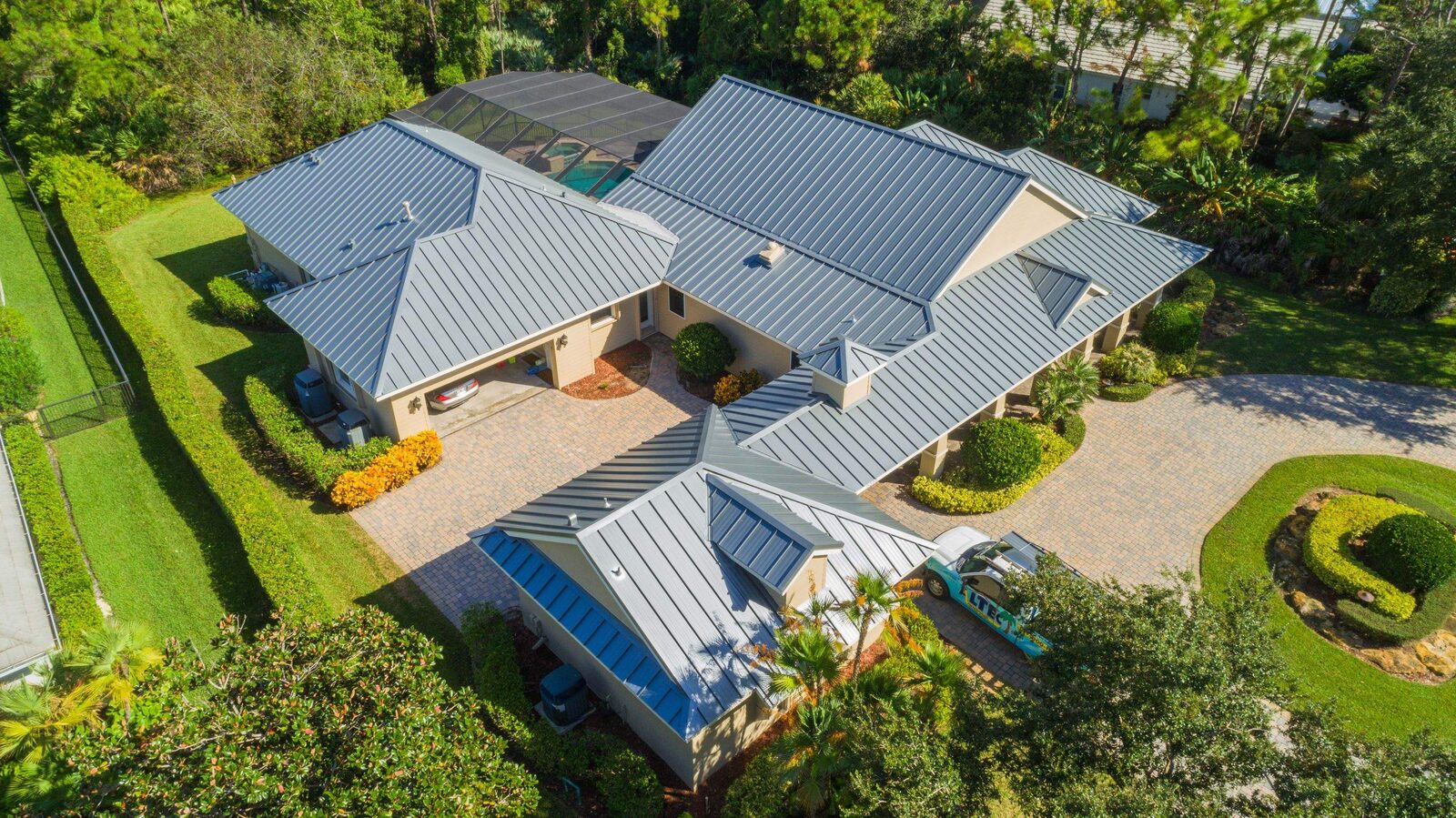
Overview
Metal tile panels are steel or aluminum roofing panels stamped and coated (either with painted PVDF/Kynar finishes or embedded stone granules) to replicate the rolling barrel profile of Spanish/Mediterranean clay tile or the scalloped look of European tile roofs, while weighing roughly 1/8 to 1/15 of real clay or concrete tile. Leading US residential products include DECRA Villa Tile/Tile (stone-coated 26-gauge steel), Interlock Mediterranean Tile (0.028" painted aluminum), Metro Roman/Villa Tile, Gerard, Boral Steel, Best Buy Metals' Stile Spanish Tile (26-gauge Kynar-coated steel), and Worthouse DURA (German steel). They target homeowners who want the Spanish/Mediterranean/Mission architectural look without clay's weight, fragility, and structural-reinforcement requirements, and are positioned as the premium, most decorative tier of the residential metal roofing category — generally the most expensive metal profile per installed square foot, competing directly against real concrete and clay tile on cost rather than against standing seam or corrugated panels.
Specifications
| Materials | 26-gauge stone-coated steel (e.g., DECRA Villa Tile/Tile), 24-26 gauge Kynar 500/Hylar 5000 PVDF-painted G90 galvanized steel (e.g., Best Buy Metals Stile, Worthouse DURA), 0.028"-0.032" painted aluminum alloy 3003-H24/3105-H24 (e.g., Interlock Mediterranean/DURA aluminum) |
|---|---|
| Profiles | Barrel/Spanish tile (rounded S-curve simulating individual clay barrels), Mediterranean scalloped tile, Villa/Mission tile, Roman tile (flatter, ribbed variant) |
| Gauge / thickness | Steel: 24-26 gauge (~0.018"-0.022"); DECRA Villa Tile specifically 26-gauge, 0.0179" (0.455mm) steel core. Aluminum: ~0.028"-0.032" (0.71-0.81mm) nominal, e.g., Interlock at 0.028" (3003-H24 or 3105-H24 alloy per ASTM B209). |
| Panel widths | Varies by manufacturer: roughly 21.5" coverage width (Interlock) up to ~39.4" coverage width (Best Buy Metals Stile), typically supplied as multi-simulated-tile-wide panels with 15"-18" exposure per course; panel lengths often custom-cut in the field from stock lengths (e.g., 3'-20'). |
| Material cost | $4–$8/sq ft |
| Lifespan | 40–70 yr |
| Wind rating | Commonly warranted to 120 mph; premium products carry Miami-Dade/Florida Building Code (e.g., FL7263-R7) and ICC-ES approvals (e.g., ESR-1790), with some panels lab-tested for uplift resistance well beyond warranted levels (DECRA cites lab testing to roughly double its 120-mph warranted wind speed) and UL90 wind-uplift passage on tile-profile through-fastened systems. |
| Fire rating | Class A fire rating as part of a tested assembly (typically requires a specified underlayment, e.g., GAF VersaShield or similar fire-rated membrane, per manufacturer instructions) — metal itself is noncombustible but assembly rating depends on underlayment/deck. |
| Hail performance | Premium products carry UL 2218 Class 4 impact resistance (the highest rating), warranted against hail up to ~2-2.5" diameter (DECRA warrants hail to 2.5"); this Class 4 rating is the basis for insurance premium discounts in many states (commonly cited in the 10-35% range depending on state/insurer, though this varies widely and should be verified with the homeowner's carrier). |
| Weight | Light to moderate for metal: ~70 lbs/square (100 sq ft) for aluminum tile systems (Interlock) up to ~150 lbs/square (0.91-1.5 lb/sq ft) for stone-coated steel tile (DECRA), versus 500-1,200+ lbs/square for real clay or concrete tile — no structural reinforcement typically needed on standard residential framing. |
| Fastener type | Predominantly concealed/hidden interlocking fastener systems on premium lines (Interlock, DECRA); some tile-profile panels (e.g., Stile Spanish Tile) are through-fastened to battens/purlins with color-matched screws. Batten or counter-batten systems are common to create airflow and the raised "barrel" shadow line. |
Pros
- Roughly 1/8 to 1/15 the weight of real clay or concrete tile (e.g., ~70 lbs/square for aluminum tile vs. 500-1,200+ lbs/square for clay), so it can be installed on standard residential framing without structural reinforcement, and often directly over existing roofing where code allows
- Delivers the Spanish/Mediterranean/Mission architectural look demanded by HOAs and regional style codes (common requirement in parts of Florida, California, Arizona, Texas) without clay's fragility
- UL 2218 Class 4 hail impact resistance on premium lines, frequently qualifying homeowners for insurance premium discounts
- High wind-uplift resistance, commonly warranted to 120 mph with some products lab-tested well beyond that, plus Miami-Dade/Florida Building Code and ICC-ES approvals available on leading products
- Long, often lifetime, manufacturer warranties (DECRA: lifetime limited, transferable 20 years; Interlock: lifetime non-prorated, transferable once) versus 20-50-year warranties on real tile underlayment/fasteners
- Low maintenance versus clay/concrete tile — no re-pointing, minimal cracking risk from foot traffic or freeze-thaw, no biological growth issues typical of porous clay
- Reflective/cool-roof coatings available, improving energy performance versus dark clay or asphalt
- Real clay/tile-adjacent resale and curb-appeal value at a lower total lifecycle cost (no periodic tile replacement/re-bedding)
Considerations
- Highest-cost segment of the metal roofing category, often approaching or exceeding real concrete tile once fully installed
- Stone-coated versions rely on a granule/acrylic surface that can shed granules over decades and is harder to field-touch-up than a painted panel
- Fewer installers are trained on tile-profile metal panel detailing (hips, valleys, ridge closures) than on standard standing seam, so labor quality varies regionally
- Panel-to-panel color/batch matching can be more visible on a curved barrel profile than on a flat panel
- Through-fastened tile systems (vs. concealed-fastener) can be more prone to long-term fastener back-out and leak points if not properly battened/detailed
- Heavier than standing-seam steel/aluminum (though far lighter than clay), so older/marginal framing should still be checked
- Noise transmission during heavy rain/hail is higher than clay or asphalt unless solid decking, underlayment, or insulation is used
- Aesthetic is a stylized simulation of clay, not identical, and can read as 'obviously metal' at close range depending on product tier
Where Metal Tile Panels (barrel/Mediterranean/Spanish tile profile) performs best
Climates
- hot/arid Southwest (Arizona, Nevada, inland CA)
- hurricane-prone Gulf Coast and Florida
- hail-prone Plains/Rocky Mountain states
- wildfire-prone areas needing Class A assemblies
- coastal/high-salt-spray regions (aluminum variants)
- freeze-thaw regions where real clay tile cracks
Home Styles
- Spanish Colonial / Spanish Revival
- Mediterranean
- Tuscan/Italianate
- Mission/Mission Revival
- Santa Fe / Pueblo Revival stucco homes
- Florida coastal/Key West style
- Southwestern ranch
Sherwin-Williams Finish
Painted (non-stone-coated) steel/aluminum tile panels are finished with PVDF resin coil coatings in the Kynar 500/Hylar 5000 performance class (70% PVDF), which is the same coating chemistry family as Sherwin-Williams' Fluropon coil/extrusion coatings — a strong architectural/technical fit for SW's coil coating business on the painted-metal-tile segment. Stone-coated tile products (DECRA-type), however, use a granule-in-acrylic-film surface rather than a liquid coil coating, so they are not a direct fit for SW coil coatings and instead represent an adjacent, largely non-addressable segment unless SW supplies the acrylic granule-adhesion coating itself.
Look & Aesthetics
Manufactured to replicate the rolling barrel/scalloped silhouette of Spanish, Italian, and Mediterranean clay/concrete tile. Two distinct visual families exist: (1) stone-coated steel tile (DECRA Villa Tile, Metro Tile, Boral/Gerard) where a stone-granule surface is embedded in acrylic film for a matte, textured, terracotta-like look; and (2) smooth painted PVDF-coated steel or aluminum tile panels (Interlock Mediterranean, Best Buy Metals Stile Spanish Tile, Worthouse DURA) which read as a glossier, more uniform "faux clay" with crisp barrel shadow lines. Panels are typically installed in multi-tile-wide sheets (3-5 simulated barrels per panel) rather than individual pieces, so field seams are far less frequent than real tile, though butt/end laps and hip/ridge/rake trim still need color-matched accessories to sell the illusion up close.
What Drives Installed Cost
Material-only costs run roughly $4-$8/sq ft ($400-$800 per 100-sq-ft "square"); fully installed costs for stone-coated/metal tile systems run notably higher than standing seam or corrugated, commonly cited at $14-$22/sq ft installed ($1,400-$2,200 per square), with some full-project national averages spanning $1,700-$4,500 per square depending on roof complexity, slope, battens/ventilation, and region. This makes metal tile the most expensive segment within residential metal roofing, priced to compete with real clay/concrete tile rather than with cheaper metal profiles.
Warranty
Leading products offer lifetime (non-prorated) limited warranties on the panel/substrate: DECRA offers a Lifetime Limited Warranty covering wind up to 120 mph and hail to 2.5" diameter, transferable to a new owner for 20 years after installation. Interlock offers a "Guardian" lifetime limited non-prorated warranty for the original owner with one-time transfer (50-year coverage to the next owner, $300 transfer fee) and a separate 30-year coating warranty (chalk/fade resistance, <5 Delta E color change). Best Buy Metals' Stile Spanish Tile carries a 50-year limited warranty with a 30-year fade/chalk warranty on the Kynar/Hylar finish.
Get matched with a certified MetalVue installer
Compare Metal Tile Panels (barrel/Mediterranean/Spanish tile profile) pricing and options with a free, no-obligation estimate.