
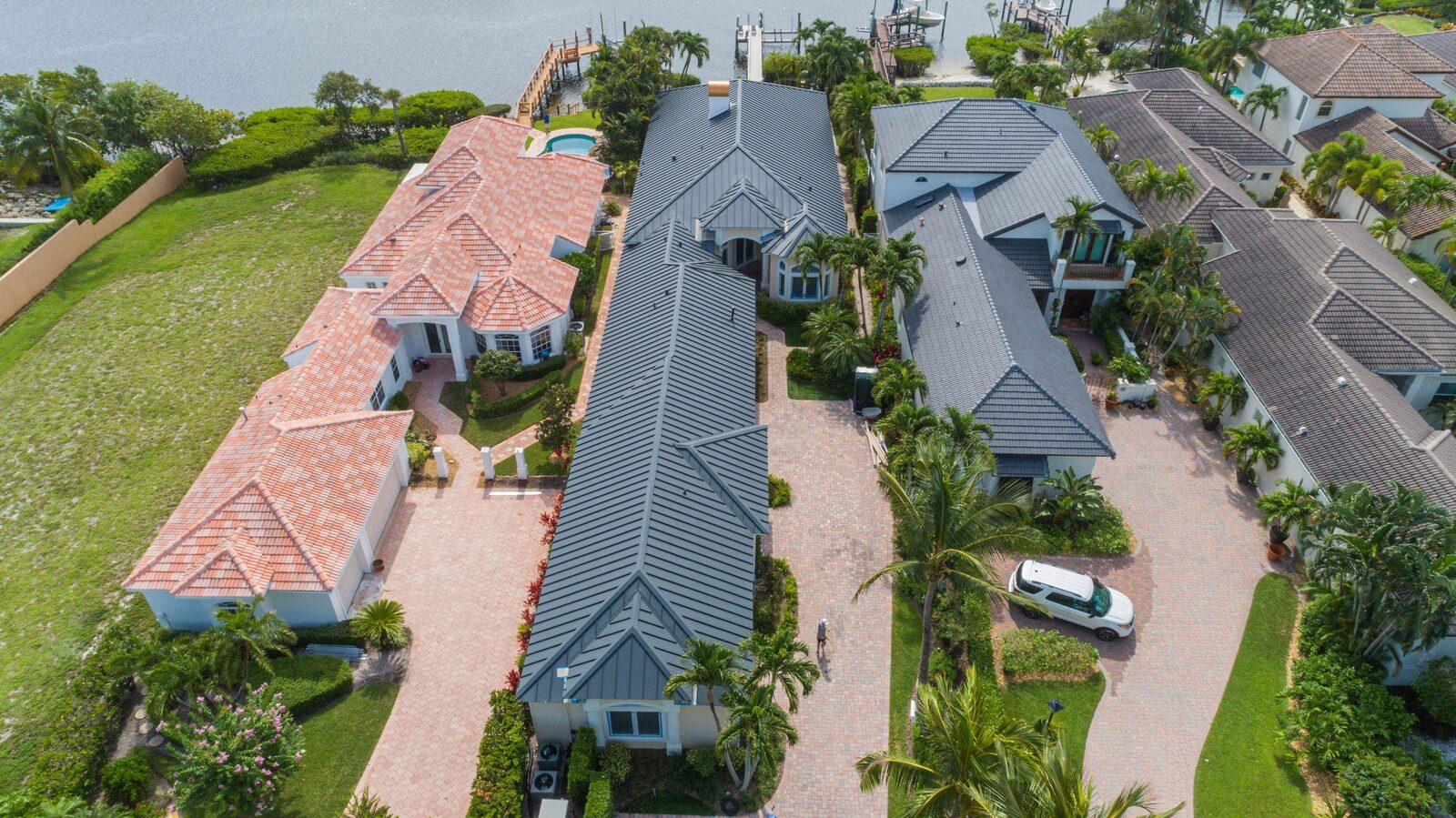
Overview
A group of premium/custom architectural metal roof profiles for US residential use — flat-lock (soldered flat seam), batten-seam, curved/radius, tapered (turret/conical), and mansard panels — priced and fabricated as bespoke systems rather than stock panel lines.
Specifications
| Materials | Copper, Lead-coated copper, Freedom Gray copper, Zinc, Galvalume/galvanized steel, Kynar/PVDF-painted (coil-coated) steel, Kynar/PVDF-painted aluminum |
|---|---|
| Profiles | Flat-lock / soldered flat seam, Batten seam with wood sub-batten, Snap-on batten seam (e.g., McElroy Medallion I/II), Curved/radius standing seam (e.g., McElroy Maxima ADV, 138T, 238T, Maxima 1.5), Curved batten seam, Tapered/conical standing seam or flat-lock (turret roofs), Mansard flush wall-style panel, Mansard corrugated panel |
| Gauge / thickness | Steel: 22-26 gauge (24 ga most common for exposed/curved work, 22 ga for higher-end batten/architectural). Aluminum:.032"-.040" typical (0.032 common for flat-lock/curved). Copper: 16-20 oz/sq ft (roughly 0.021"-0.027"); zinc and lead-coated copper in comparable weight classes. |
| Panel widths | Flat-lock pans: commonly 18"x24" (copper, 10 pans per 3'x10' sheet) or 24"x30" (aluminum/steel, 4'x10' sheet). Batten-seam: field pan widths vary by manufacturer with a batten cap roughly 2" wide x 1.75" high covering the seam. Curved/radius and tapered: panel width follows the base standing-seam/batten profile (commonly 12"-19" coverage) but narrows progressively for tapered/conical applications and is curved to project-specific radius. |
| Material cost | $6–$40/sq ft |
| Lifespan | 40–100 yr |
| Wind rating | Published third-party wind-uplift ratings specific to flat-lock, batten-seam, curved, tapered, and mansard configurations are limited compared to mainstream standing-seam panels; mainstream standing-seam systems commonly test to 140 mph+ when properly installed, and curved/batten variants inherit similar performance when installed per manufacturer assembly specs, but homeowners in high-wind zones should confirm project-specific engineering/test data with the fabricator rather than assume a blanket rating. |
| Fire rating | Class A fire rating is achievable for metal roof assemblies in this category when installed over an approved cover board/underlayment per manufacturer assembly listing (metal itself is noncombustible); published Class A listings for the niche flat-lock/batten/curved/tapered assemblies specifically are less commonly documented by manufacturers than for mainstream standing seam. |
| Hail performance | Class 4 UL 2218 impact resistance is achievable on heavier-gauge painted steel versions of these profiles, similar to mainstream standing seam, but softer metals used in flat-lock/batten traditions — copper, aluminum, zinc — are more susceptible to denting from large hail than 24-26 ga steel; manufacturer-specific hail test data for curved/tapered/mansard configurations is not consistently published. |
| Weight | Copper and zinc are the heaviest common choices (16-20 oz/sq ft copper); painted steel is mid-weight (22-26 ga); aluminum is the lightest (.032"-.040"), valued for curved/tapered work where malleability eases forming. |
| Fastener type | Concealed. Flat-lock: panels folded, double- or single-locked a minimum of 1/2", crimped, and soldered (50/50 solder, rosin flux, 3-lb+ iron) for true weatherproofing on low-slope; unsoldered "water-shedding" installs need steeper slope. Batten-seam: panel edges turned up over wood or metal sub-battens (or a snap-on batten cap system, e.g., McElroy Medallion I/II, ~1.75" high x 2" wide cap) that conceals all fasteners. Curved/radius: standard concealed clip-and-seam standing-seam or batten hardware, factory- or field-curved. Tapered: custom-narrowed concealed-fastener pans converging at an apex, typically hand-formed for turret/conical applications. |
Pros
- Unmatched architectural distinction — the go-to category for historic accuracy (Second Empire mansards, Victorian turrets) and high-end custom homes
- Copper, zinc, and lead-coated copper offer exceptional 60-100+ year service life and develop a protective, self-healing natural patina requiring no repainting
- Soldered flat-lock seams are fully weatherproof (not just water-shedding), enabling use on very low-slope (<3:12) mansard faces and flat sections
- Curved/radius systems let standing-seam and batten-seam aesthetics extend onto barrel roofs, turrets, domes, and eyebrow dormers with factory-consistent seam lines and coating/color match to adjacent straight panels
- Batten-seam's raised cap adds shadow-line texture and a traditional, bespoke look distinct from flat standing seam
- Tapered/conical panels solve the geometry problem of turret roofs cleanly, avoiding the patchwork look of forcing standard panels onto a cone
- Concealed-fastener construction across all five profiles avoids exposed screw penetrations
- Mansard applications benefit from metal's durability on a roof plane that is highly visible (steep, near-vertical) from the street
Considerations
- Highest labor cost of any residential metal roof category — hand-fabrication, soldering, and field-curving/tapering are skilled-trade, time-intensive work
- Few installers nationally are truly qualified (soldering flat-lock copper/zinc correctly is a specialized craft); poor workmanship causes leaks
- Bare copper, zinc, and lead-coated copper are not painted/coated products, so Sherwin-Williams Fluropon/Kynar coatings do not apply to those variants — only the painted steel/aluminum versions of these profiles take a coil coating
- Flat-lock and batten-seam are water-shedding (not fully sealed) systems unless seams are soldered, so minimum-slope and underlayment requirements must be followed carefully; flat-lock without soldering is unsuitable below 3:12
- Curved and tapered panels require a minimum radius specific to each profile/material combination — tighter radii are not achievable on every panel line
- Softer metals (copper, aluminum, zinc) are more prone to denting/oil-canning than heavier-gauge steel
- Manufacturer published wind, hail, and fire test data is sparse for these niche profiles compared to mainstream standing-seam and exposed-fastener panels
- Significant cost premium (often 1.5x-3x mainstream standing seam) for architectural effect that also drives up install-labor share of total cost to roughly 60-70%
Where Architectural/Specialty Metal Roof Profiles: Flat-Lock, Batten-Seam, Curved/Radius, Tapered, Mansard performs best
Climates
- Coastal/humid (copper and zinc patina well and resist salt corrosion)
- Historic/older-home climates where traditional materials (copper, zinc, lead-coated copper) are code- or HOA-required
- Cold/snow climates for curved barrel roofs that shed snow smoothly
- Mixed climates for painted steel/aluminum versions of these profiles, given proper coating selection
Home Styles
- Second Empire / Mansard-style homes (flat-lock or corrugated mansard cladding)
- Victorian, Queen Anne, French Eclectic (turret/conical tapered panels, curved dormers)
- French Provincial, Gothic Revival, Richardsonian Romanesque, high-end custom estates (batten-seam)
- Modern/minimalist flat or low-slope residential (flat-lock)
- Craftsman/bungalow porch roofs and bay windows (small-format flat-lock accents)
Sherwin-Williams Finish
Only the painted (coil-coated) steel and aluminum versions of these profiles are candidates for Sherwin-Williams/Valspar-class Fluropon (70% PVDF/Kynar 500) or SMP coil coatings — applicable to flat-lock, batten-seam, curved, tapered, and mansard panels fabricated from painted steel or aluminum coil. Bare/natural copper, zinc, and lead-coated copper — the traditional and most common materials for flat-lock and batten-seam work — are uncoated, mill-finish or patina-forming metals and fall outside the coil-coating value proposition entirely (patina is the finish, not a paint system). For MetalVue positioning, this category is best marketed as "premium PVDF finishes for architectural steel/aluminum panel profiles," while acknowledging that the highest-prestige historic/luxury segment of this category (copper, zinc) is a non-coated-metal market SW coatings do not address.
Look & Aesthetics
This group covers the premium/custom end of residential metal roofing where the panel itself becomes an architectural statement rather than a commodity covering. Flat-lock (flat-seam) reads as a smooth, jewel-like plane of small interlocking pans (traditionally 18"x24" copper or 24"x30" aluminum/steel) with soldered or folded seams — historically seen on mansard faces, dormers, bays, turrets, and porch roofs of Second Empire, Victorian, and French Eclectic homes, and increasingly on modern flat/low-slope minimalist homes. Batten-seam adds raised, boxy vertical battens (roughly 1.75"-2" high, 2" wide caps) over the panel seams, giving a heavier, more traditional/old-world rhythm favored on Richardsonian Romanesque, Gothic Revival, French Provincial, and high-end custom estate homes, churches, and civic-style residences. Curved/radius panels (barrel/turret/dome/eyebrow dormers, gambrel or barrel-vault roofs) extend standing-seam or batten profiles around a bend, factory- or field-curved to a minimum radius that varies by profile and metal. Tapered panels are custom-narrowed standing-seam or flat-lock pans that converge to a point, used almost exclusively on conical turret/witch's-hat roofs on Queen Anne and Victorian homes. Mansard panels are typically flat-lock, corrugated, or flush/snap-on-batten profiles installed on the steep, near-vertical lower slope of a mansard roof, sized and detailed more like a wall-cladding system than a low-slope roof system. All five are labor-intensive, hand- or shop-fabricated, and priced and marketed as premium/custom rather than stock catalog items.
What Drives Installed Cost
Installed pricing spans roughly $6-$12/sq ft for mansard-style corrugated/flush panels up to $20-$40/sq ft for architectural copper flat-lock or batten-seam work; curved and tapered fabrication typically adds a custom/shop-forming premium on top of base material and standard install costs. Installation labor (cutting, soldering, seaming, curving/tapering) commonly represents 60-70% of total job cost for these hand-fabricated profiles, higher than for stock standing-seam or exposed-fastener panels.
Warranty
Painted steel/aluminum versions typically carry standard coil-coating warranties (20-35 years against fade/chalk for PVDF-class finishes, shorter for SMP), consistent with mainstream metal roofing. Bare copper, zinc, and lead-coated copper carry no paint/finish warranty since there is no applied coating — longevity claims (60-100+ years) rest on material durability and correct fabrication/soldering rather than a manufacturer coating warranty. Workmanship/installation warranties for these hand-fabricated profiles vary widely by fabricator/installer and are not standardized across the industry the way panel-material warranties are.
Get matched with a certified MetalVue installer
Compare Architectural/Specialty Metal Roof Profiles: Flat-Lock, Batten-Seam, Curved/Radius, Tapered, Mansard pricing and options with a free, no-obligation estimate.