
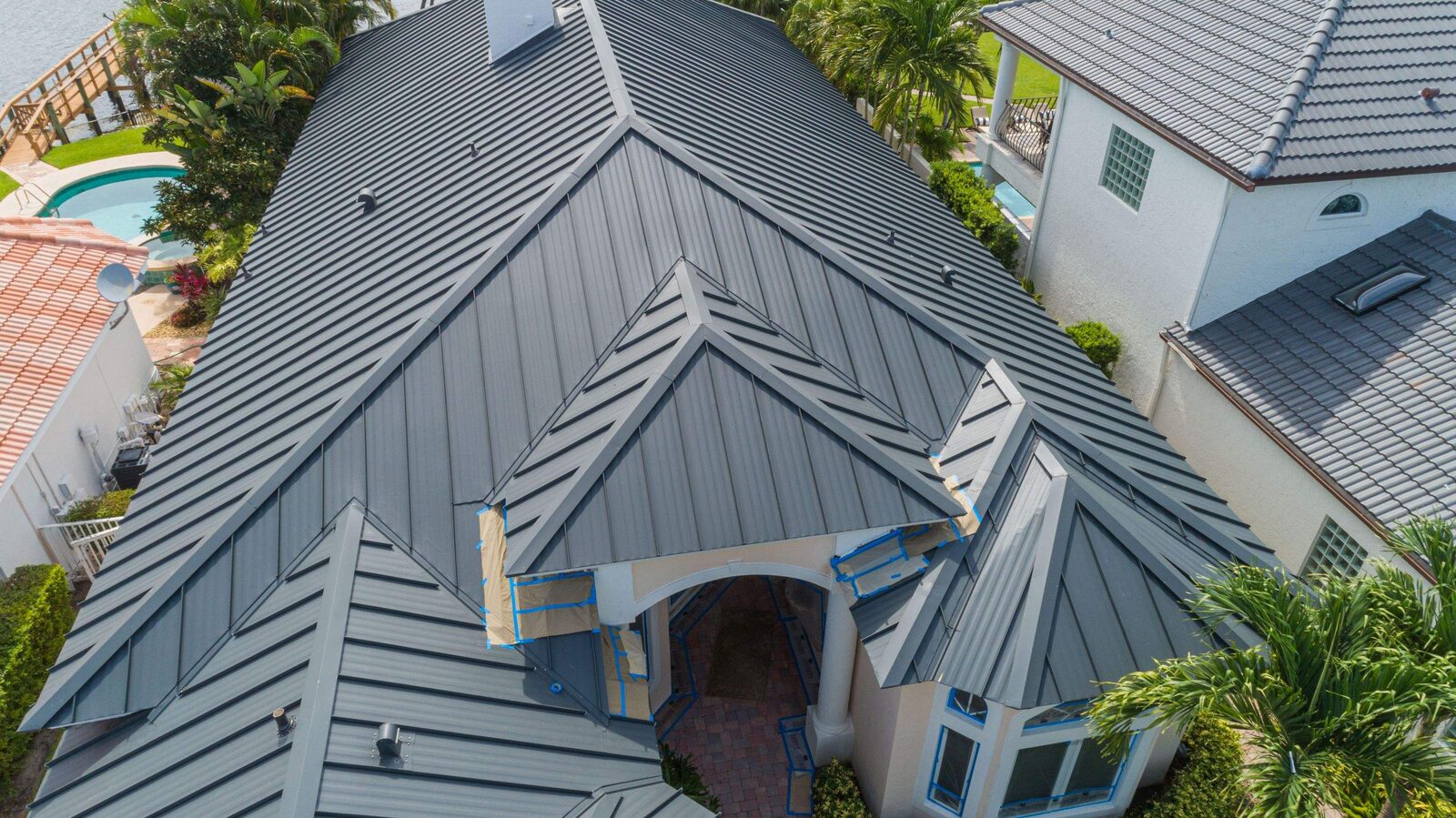
Overview
Aluminum roofing is a lightweight, naturally corrosion-resistant metal roofing material used in standing-seam panels, interlocking shingles, shakes, tile-profile, and slate-profile products for residential US roofs. Unlike steel, which relies on a zinc (galvanized) or zinc-aluminum alloy (Galvalume) coating for rust protection, aluminum forms its own self-healing aluminum-oxide layer on exposure to air, giving it superior resistance to salt-air corrosion. This makes it the preferred metal-roofing substrate for homes within roughly 1-3 miles of the ocean or other high-salt-air environments, where steel roofing (even Galvalume) is prone to red-rust at cut edges, fasteners, and panel penetrations over time. Aluminum is roughly one-third the density of steel, so aluminum roofing systems are notably lighter per square (about 40-70 lbs/square depending on profile) — a benefit for structures with load limitations or retrofit applications. It is typically supplied in.032" to.050" thickness (commonly described as approximately 24-28 gauge steel-equivalent, though gauge/thickness comparisons across metals are approximate), with.032" being the standard entry-level residential thickness and.040"+ used for improved rigidity, reduced oil-canning, and better ice/impact resistance. As a softer metal than steel, aluminum roofing dents more easily under large hailstones, though such dents are cosmetic only and do not compromise the panel's waterproofing or service life. Aluminum roofing commonly carries lifetime transferable warranties and typically lasts 50+ years, and it accepts premium PVDF (Kynar 500/Hylar 5000) factory finishes with excellent long-term color and film adhesion performance, well suited to Sherwin-Williams-grade coil-coating programs.</description> <parameter name="fastener_type">Concealed clip-and-seam fasteners for standing seam (floating clips accommodate thermal movement); exposed or concealed stainless-steel or aluminum fasteners for shingle/shake/tile profiles — fasteners and any flashing/trim must be aluminum-compatible (avoid direct contact with copper or bare carbon steel) to prevent galvanic corrosion.
Specifications
| Materials | Aluminum (3000- and 5000-series alloys typically used for roofing coil stock), PVDF/Kynar 500 or Hylar 5000 factory-applied paint finishes, Mill-finish/unpainted (mostly for select architectural applications, less common residential) |
|---|---|
| Profiles | Standing seam (snap-lock and mechanically seamed), Interlocking shingles, Shake profile, Tile profile, Slate profile, Corrugated/exposed-fastener panels |
| Gauge / thickness | Residential aluminum roofing is typically supplied in.032" to.050" thickness..032" is the standard/entry-level residential gauge (lightweight, sufficient rigidity for typical spans);.040" is a common step-up for better rigidity, reduced oil-canning, and improved ice/impact resistance (roughly 20-25% cost premium over.032");.050"+ is used for premium/high-performance or purlin-spanning applications. These are loosely equivalent to 24-28 gauge in steel terms, though aluminum and steel gauge/thickness comparisons are not directly interchangeable due to differing density and stiffness. |
| Panel widths | Varies by profile and manufacturer; standing-seam aluminum panels are commonly available in coverage widths similar to steel standing seam (roughly 12"-19" typical coverage width), with interlocking shingle/shake/tile/slate-profile products sized per individual manufacturer specifications (e.g., Interlock's shingle, shake, slate, and tile lines). |
| Material cost | $7–$21/sq ft |
| Lifespan | 50–70 yr |
| Wind rating | Aluminum standing-seam systems are engineered and tested to high wind-uplift ratings (commonly meeting Miami-Dade/Florida Building Code and ASTM E1592/UL 580 wind-uplift requirements) when properly installed with rated clip spacing and fastening — critical for hurricane-prone coastal markets where aluminum is most commonly specified. |
| Fire rating | Class A fire rating (noncombustible metal), consistent with steel and other metal roofing. |
| Hail performance | Aluminum roofing products can achieve UL 2218 Class 4 impact ratings (the highest classification) in tested profiles/thicknesses, but aluminum is inherently a softer metal than steel and is more prone to cosmetic denting from hailstones roughly 1 inch or larger in diameter. Dents do not cause corrosion, leaks, or reduced service life — the damage is cosmetic only. Homeowners in severe hail-prone regions (e.g., parts of the central Plains/Hail Alley) may prefer thicker aluminum gauges (.040"+) or opt for steel where dent resistance is the top priority. |
| Weight | Lightweight relative to other roofing materials: approximately 40-70 lbs per square (100 sq ft), roughly one-third the density of comparable steel roofing by volume, and dramatically lighter than slate or concrete tile. |
Pros
- Superior corrosion resistance in salt-air/coastal environments due to self-healing aluminum-oxide layer — does not rust like steel
- Significantly lighter weight (~40-70 lbs/square) than steel, tile, or slate, easing structural load requirements
- Long service life, commonly 50+ years, often backed by lifetime transferable warranties
- Excellent compatibility with premium PVDF/Kynar 500 coil coatings for long-term color and film retention
- Can achieve top-tier UL 2218 Class 4 hail impact ratings in tested configurations
- Class A fire rating
- Available in a wide range of profiles (standing seam, shingle, shake, tile, slate-look) for varied home styles
- Cosmetic dents from hail/debris do not compromise waterproofing or longevity, unlike corrosion-driven failure modes in steel
Considerations
- Softer metal than steel — dents more readily from hail 1 inch or larger and from foot traffic/debris impact
- Higher material cost than steel per square foot in most panel types
- Lower structural stiffness at thin gauges can lead to oil-canning (wavy panel appearance) unless a thicker gauge (.040"+) or striations/stiffening ribs are used
- Higher thermal expansion/contraction coefficient than steel, requiring correct floating-clip standing-seam detailing
- Requires isolation from dissimilar metals (e.g., direct contact with copper or certain fasteners) to avoid galvanic corrosion
- Less widely stocked/installed by roofers than steel in many inland US markets, which can affect installer availability and bid competition
Where Aluminum performs best
Climates
- Coastal / salt-spray environments (within ~1 mile of ocean)
- Humid subtropical / high-salt-air regions
- Freeze-thaw climates (flexible coating resists cracking)
- Areas prioritizing corrosion resistance over hail resistance
Home Styles
- Coastal cottages and beach houses
- Modern/contemporary homes (standing seam)
- Traditional homes seeking shingle/shake/slate/tile-look metal panels
- Homes prioritizing lightweight roofing (older structures, additions with load limits)
Sherwin-Williams Finish
Aluminum is one of the best substrates for premium liquid and coil-applied fluoropolymer (PVDF/Kynar 500) finishes: its surface accepts factory-baked coatings with excellent long-term adhesion, color retention, and flexibility through thermal cycling, supporting 20-40 year film-adhesion warranty claims typical of PVDF systems. This makes aluminum a strong substrate match for a Sherwin-Williams MetalVue coil-coating and field-touch-up paint/coating product line, particularly for coastal SKUs/marketing where steel's corrosion limitations are the key differentiator being sold against.
Look & Aesthetics
Aluminum takes PVDF/Kynar 500 factory finishes exceptionally well and holds color/gloss over decades due to strong coating adhesion and flexibility during thermal cycling. Available in the full range of standing-seam, shingle, shake, tile, and slate-profile aluminum products (e.g., Interlock lines), so it can mimic traditional roofing aesthetics while retaining metal durability. Because it dents more readily than steel, hail-prone regions may show cosmetic dimpling over time, which is purely aesthetic and does not affect waterproofing or lifespan.
What Drives Installed Cost
Fully installed costs run about $7-$18/sq ft for most aluminum roofing types ($7-$14/sq ft for corrugated aluminum, $10-$17/sq ft for standing seam panels, $7-$16/sq ft for interlocking aluminum shingles), rising to $17-$21/sq ft for insulated aluminum panel systems. For a typical 3,000 sq ft roof, total installed cost commonly falls between about $21,000 and $51,000, with a national average near $30,000. Aluminum generally costs somewhat more than comparable steel systems, reflecting its higher raw-material cost, offset over the life of the roof by corrosion-resistance value in coastal applications.
Warranty
Aluminum roofing systems commonly carry lifetime transferable warranties from manufacturers on the substrate/material itself (reflecting aluminum's corrosion resistance), with separate finish warranties (typically 20-40 years) covering PVDF/Kynar 500 paint film adhesion, chalk, and fade performance.
Get matched with a certified MetalVue installer
Compare Aluminum pricing and options with a free, no-obligation estimate.